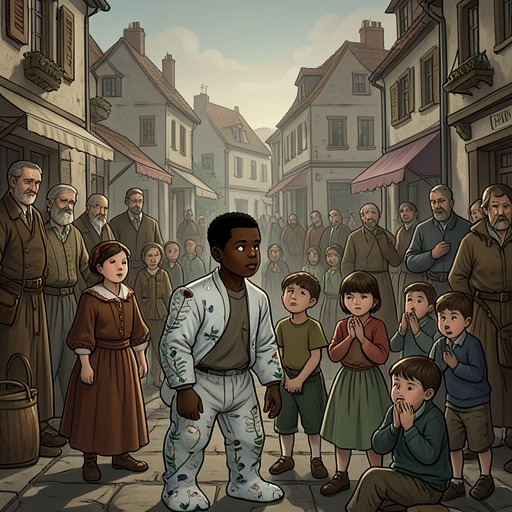
Kalmyk cavalrymen
The Painted BirdThe Kalmyk cavalrymen are German-aligned mounted auxiliaries whose arrival brings a feared village raid into view and makes the boy’s exclusion painfully personal. The villagers have heard stories of their role in punitive campaigns; when the riders appear, the boy recognizes in their dark features a resemblance to himself, but the violence he witnesses makes that resemblance a source of dread rather than belonging.
Identity and Background
The riders arrive in a band of perhaps a hundred or more, mounted and moving without a formal formation. They wear green German uniforms, bright buttons, and forage caps; some carry sabers, and some ride without saddles. The account presents them as an irregular force, distinguished by their horsemanship and by the speed and disorder of their movement through the village.
The peasants’ understanding of who they are comes from months of rumor and reported experience. They believe that the Kalmyk cavalrymen were mostly volunteers and deserters from the Soviet side who joined the German forces out of hostility to the Reds. According to these accounts, the German Army permitted them to loot and rape in the course of their military service, and sent them to settlements marked for punishment, especially places along the Red Army’s advancing path. The villagers’ response to the riders is therefore shaped by accumulated fear before the attack begins.
Arrival and the Village Raid
The riders enter just after the villagers have seen signs that the German forces are withdrawing. The village had learned that the Germans had lost the war, but the next day the mounted band appears. The peasants recognize them and call for women and children to hide. The warning comes too late to allow an orderly escape, and the riders gallop among the houses as the community breaks into confusion.
Some of the cavalrymen are already drunk. They enter huts and seize women who have not been concealed. Men attempt to defend them with scythes; one is killed with a saber, while others trying to flee are shot. The riders spread through the village, and the boy watches from a dense patch of raspberry bushes in the square. The raid is shown not as an isolated clash between armed forces but as violence imposed on people who have little means of resisting it.
The attack also overturns the villagers’ ordinary sense of safety and religious protection. An elderly, blind man whom they call a saint comes out holding a large wooden cross and reciting a psalm. The riders briefly hesitate, but one trips him and knocks the cross away. Later, a cavalryman sets the cross upright so that it falls onto the old man, who stops moving. The episode places a sacred emblem in the hands of the attackers and shows that neither age nor religious devotion shields the villagers from them.
The Boy and the Burden of Resemblance
The boy’s position in the raid is that of a hidden witness, not a participant. From the bushes, he watches the riders and identifies their dark hair, eyes, and skin as darker than his own. For a moment, their difference from the fair-haired villagers gives him a feeling of pride. That response changes as he witnesses the attack: he concludes that the shared features mark him as belonging to the same feared category as the cavalrymen.
This is a conclusion produced by the boy’s circumstances, not proof that he has any connection to the riders. Earlier in the novel, villagers have treated his olive skin, dark hair, and eyes as evidence that he is a Gypsy or Jewish stray. The cavalrymen’s arrival intensifies that imposed classification by giving it a violent image. In the boy’s understanding, his appearance seems to explain the unanswered prayers, the abuse he has endured, and his loss of speech. The scene turns resemblance into another form of isolation: he sees himself through the same racialized suspicion that has already made him vulnerable to others.
Defeat and Aftermath
The raid is interrupted when Soviet forces approach from the river and the forest. An explosion and sustained gunfire announce their arrival; a low-flying plane bears a red star, and tanks enter the area. The bridge has been destroyed, but the Red Army continues toward the village. Some of the Kalmyk cavalrymen hide near haystacks, then emerge and surrender as the tanks approach. Soldiers round up most of them, while their horses graze nearby.
The boy initially thinks the war may be over, but the aftermath brings another form of violence. At noon, the village learns that the captured cavalrymen have been hanged from oak trees along the river. The boy follows the crowd there despite his pain. Women who recognize their tormentors curse them and throw dirt and pieces of wood at the bodies. The account thus ends the riders’ control of the village through capture and execution, without presenting the Red Army’s arrival as a simple restoration of peace.
Narrative and Historical Context
The cavalrymen’s narrative importance lies in the collision between a historical military role and the boy’s intensely personal experience of appearance-based exclusion. Their brief arrival makes visible the way wartime categories can become a threat even to a child who has no stated connection to the armed group. The boy is left to confront the fear that others may identify him by outward resemblance rather than by his actions or identity.
The novel’s afterword also invokes survivor testimony describing German troops arriving with Kalmyk forces to punish an Eastern European village. That testimony is presented as historical evidence in the author’s response to critics who considered the novel’s violence excessive; it is distinct from the novel’s narrated village raid. The distinction matters: the riders in the plot are fictional characters within the boy’s account, while the afterword uses testimony to argue that the violence depicted belongs to a wider history of wartime brutality.